First a children's novel in 1982, then a hit stage adaptation in 2007, and now a massive motion picture helmed by the generation's most iconic director, War Horse's rising commercial success is almost an exact parallel of the story it tells within its self. After being thrust into unfamiliar territory, far from its humbling roots, both the evolution of this tale's adaptations and its very own hero, Joey (a born and bred British horse) rise to their respective occasions and thrive throughout their new-found paths: both on a road lined with shining gold, if this year's award nominations are to go by. Because War Horse, in true Spielbergian style, is as classically retold as the day it was written - albeit with an even larger focus on tradition, emotion and all around heart.
Young farm lad, Albert (newcomer, Jeremy Irvine, who proves to be quite the up-and-comer) is in a state of crisis when his home and family come into some serious financial problems, worsened further when his father buys a particularly strapping young horse, Joey. But the Albert and Joey phenomenally, and when Joey is sold on to serve the country in the Great War, Albert swiftly signs up to find him, leading them both into the terrifying scenarios of the First World War.

As Joey goes along his journey, his reigns are frequently swapped among the movie's supporting cast. Beginning with British cavalry men, played by rising British stars Benedict Cumberbatch (Sherlock) and Tom Hiddleston (Loki in Thor/Avengers), onto two German brothers, a sick French girl and her Grandfather, and ending up in No-Man's land, where two rival nation's morals are tested in a touching, humorous encounter worthy of applause.
Throughout Joey's adventure, his faithful owner Albert pursues him, and the two's situations are mirrored in each others. With this narrative device in play, things could have become over done - the parallels between our protagonists made too obvious - but luckily, it maintains its beauty by becoming a subtle addition to the story arc, one that may not even be noticed until after leaving the cinema. This now subconscious link between them lets us in on more of a connection that eventually aids in the eye watering finale, which comes in a such a full-circle way that it's an actual challenge to keep that lump in your throat down.
Spielberg really hones in on the raw emotion of the dramatic scenes, giving each character stage a different flair in terms of tone and heart. When matched with John Williams' thriving score of wartime brass and some astounding woodwind, you've got a living, breathing beast of a film, packed to the brim with compelling moments that tug at the heart strings, even after the credits have rolled.
Coupled with his regular cinematographer, Janusz Kaminski, Spielberg presents trench warfare and the battlefields of WWI with a sincere level of accuracy. While these scenes remain action-focused, they steer clear of intense blood and gore (Private Ryan, this is not) and instead linger on something more profound, with the actual genuine scare factor of these heightened with the urgency of the battle. And when the fighting is off screen, the time period still shows not just in terms of the story, but in the way a classic, 1940s war film would have been shot.

The gold brazened fields of Devon stand bright among the creative angles Kaminski takes with his photography, lending some of his most beautiful work to date with the tasteful scene transitions (ploughing fields into knit wear=genius) and the occasional clever cover up for death (a windmill craftily conceals an execution). It's this innovation in its storytelling that gives War Horse an edge over other companion based tear jerkers, because all the while our heroes are galivanting about in the forefront, these slight insinuations of a wider world where the reality is as grim as it gets, reminds us of how high the stakes are, and how this is very much rooted in history in an almost mythological way.
With such a deep and moving tale, Spielberg shines, bringing the very same - if not higher - emotional notes that made his career what it is. It's epic, bold and emotive, yet doesn't shy away from some typical British humour, furthering the pure potential of enjoyment. Without over stepping the mark in melodrama, we're treated to an uplifting tale of charm, ultimately boiling down to a true study of the human spirit and all its vulnerabilities. Friendship has never been more poignant.
See it for Spielberg, see it for the History, see it for the magnificent visuals, and above all, see it for the beauty. This is an emotionally charged, highly driven piece of cinema, which gives as good as it gets. Spielberg delivers on a stunningly moving movie, with enough warmth to get you through the 146 minute runtime without the slightest regret. Blistering powerful: you will need tissues.
5/5 Stars
 ATR
ATR

As Joey goes along his journey, his reigns are frequently swapped among the movie's supporting cast. Beginning with British cavalry men, played by rising British stars Benedict Cumberbatch (Sherlock) and Tom Hiddleston (Loki in Thor/Avengers), onto two German brothers, a sick French girl and her Grandfather, and ending up in No-Man's land, where two rival nation's morals are tested in a touching, humorous encounter worthy of applause.
Throughout Joey's adventure, his faithful owner Albert pursues him, and the two's situations are mirrored in each others. With this narrative device in play, things could have become over done - the parallels between our protagonists made too obvious - but luckily, it maintains its beauty by becoming a subtle addition to the story arc, one that may not even be noticed until after leaving the cinema. This now subconscious link between them lets us in on more of a connection that eventually aids in the eye watering finale, which comes in a such a full-circle way that it's an actual challenge to keep that lump in your throat down.
Spielberg really hones in on the raw emotion of the dramatic scenes, giving each character stage a different flair in terms of tone and heart. When matched with John Williams' thriving score of wartime brass and some astounding woodwind, you've got a living, breathing beast of a film, packed to the brim with compelling moments that tug at the heart strings, even after the credits have rolled.
Coupled with his regular cinematographer, Janusz Kaminski, Spielberg presents trench warfare and the battlefields of WWI with a sincere level of accuracy. While these scenes remain action-focused, they steer clear of intense blood and gore (Private Ryan, this is not) and instead linger on something more profound, with the actual genuine scare factor of these heightened with the urgency of the battle. And when the fighting is off screen, the time period still shows not just in terms of the story, but in the way a classic, 1940s war film would have been shot.
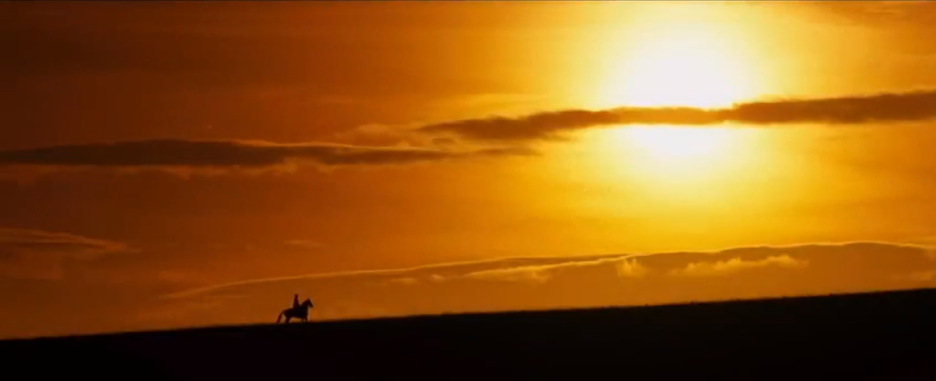
The gold brazened fields of Devon stand bright among the creative angles Kaminski takes with his photography, lending some of his most beautiful work to date with the tasteful scene transitions (ploughing fields into knit wear=genius) and the occasional clever cover up for death (a windmill craftily conceals an execution). It's this innovation in its storytelling that gives War Horse an edge over other companion based tear jerkers, because all the while our heroes are galivanting about in the forefront, these slight insinuations of a wider world where the reality is as grim as it gets, reminds us of how high the stakes are, and how this is very much rooted in history in an almost mythological way.
With such a deep and moving tale, Spielberg shines, bringing the very same - if not higher - emotional notes that made his career what it is. It's epic, bold and emotive, yet doesn't shy away from some typical British humour, furthering the pure potential of enjoyment. Without over stepping the mark in melodrama, we're treated to an uplifting tale of charm, ultimately boiling down to a true study of the human spirit and all its vulnerabilities. Friendship has never been more poignant.
See it for Spielberg, see it for the History, see it for the magnificent visuals, and above all, see it for the beauty. This is an emotionally charged, highly driven piece of cinema, which gives as good as it gets. Spielberg delivers on a stunningly moving movie, with enough warmth to get you through the 146 minute runtime without the slightest regret. Blistering powerful: you will need tissues.
5/5 Stars